Letter to Prospective Students
Thank you for your expression of interest in the graduate program of the Department of Wildlife Ecology and Conservation. We have a very diverse and exciting graduate studies program. Degrees are offered at the Master of Science level, with thesis or non-thesis options, and at the Ph.D. level.
Research conducted through the Department, and hence our graduate studies program, is as diverse as our faculty expertise. Ongoing program areas include conservation biology, landscape and restoration ecology, wildlife ecology, human dimensions of natural resource management, and tropical conservation. The many specialties within these program areas are described in the research section of the WEC website at www.wec.ufl.edu.
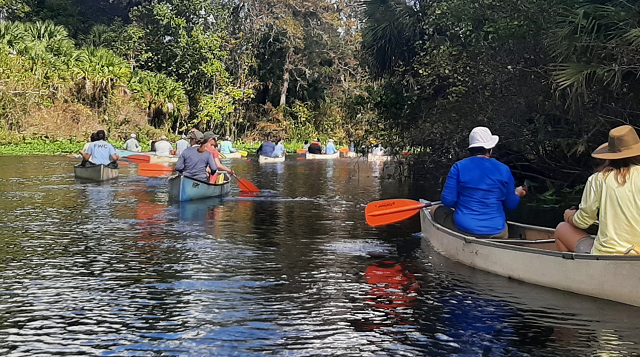
Affiliated faculty can be found in the Center for Latin American Studies, the Florida Museum of Natural History and the U.S. Geological Services Cooperative Fish and Wildlife Research Unit, to name a few. Field research, within Florida as well as in the Latin America and Africa, is a special strength of our faculty.
The first and most critical criterion for admission is having a faculty member agree to serve as your advisor. Your application is only considered after an advisor has been identified and they agree to serve as your mentor. Prospective students are responsible for contacting professors and securing agreement for sponsorship. For more information about prospective graduate advisors visit the WEC website at www.wec.ufl.edu and the home pages of WEC faculty. This process can take some time, and students are encouraged to begin making contact with prospective advisors several months before the desired admission date.
Students must have an earned Bachelor’s degree. For admission into the Ph.D. program a Master’s degree is generally required; students will be considered for admission into the Ph.D. program without a Master’s degree only under extraordinary circumstances based on significant prior experience of an exceptional nature.
The Department does not have fixed minimum criteria for GPA or GRE scores, but students are only rarely admitted with GPA <3.2 and most students admitted into the program have combined score > 1200 (Verbal and Quantitative portions) on the Graduate Record Exam (GRE). International students must have scores of 550 on the paper-based (or 213 on the computer-based) TOEFL (Test of English as a Foreign Language); unless English is the native tongue or a degree has been obtained from an institution in an English-speaking country.
Assistantship stipends are usually awarded on a 1/3-time basis and currently pay $16,000 annually, but alternative assistantship structures and salaries are sometimes possible, depending on the source of funding. . The nature of appointments vary, but many assistantships include coverage of tuition. The department has a limited number of teaching assistantships, generally assigned as part of the initial agreement with the student; some assistantships require teaching, and this will be clear in your letter of offer. A limited number of additional assistantships are available, generally to support one or two semesters of a student to enable them to complete their degree or to meet special teaching needs in the department.
Or write our Student Services Office, attn: Ms. Claire Williams, Department of Wildlife Ecology and Conservation, P.O. Box 110430, Rm. 102 Newins-Ziegler Hall, University of Florida, Gainesville, FL 32611 (Phone: 352-846-0633); Again, thank you for your interest in the Department of Wildlife Ecology & Conservation. To check the status of your application go to http://www.isis.ufl.edu/.
Sincerely,
Wiley M. Kitchens,
Professor and Graduate Coordinator